
Supply Chain Intelligence
for Capital at Risk
Build the fast branch early so the slow one meets the date. It ties up unseen cash. We analyze your bill of materials and ERP to show what's tied up and what can be reversed.
Our Clients


Nothing to install. Nothing for your suppliers to do.
The Critical Component Lead-time Pain
Want-date
- Long-lead assemblyLands late
- Medium assembly
- Fast assembly, built early in bulk
- Fast assembly, built early in bulk
Built, paid for, and waiting – this is capital at risk. And it still misses.
What changes for you?
That mismatch is going to sit with you either way. What changes is whether you can see it, price it, and decide what to do about it.
Taking on a new order
Days of spreadsheet work before anyone will say yes.
A same-day answer, checked down to component level.
Explaining working capital
The honest answer is "protection", which finance can't use.
One number, split by what caused it and how much is still reversible.
Deciding what to build early
Judgement, habit, and the lead times someone typed in years ago
Timed against what your suppliers actually deliver.
Reacting when a supplier slips
You find out what broke by reading emails.
You see which branches fall over, and what protecting them costs.
Funding what you hold
Inventory a lender can't see inside, so it can't be lent against.
A priced position, by order and by stage.
Why the money piles up in the middle of the chain
Upstream sits on contracted terms – fixed lots, long leads, someone else's schedule. Downstream matches live end demand – volatile, short notice, changing weekly. The mismatch between those two has to sit somewhere, and it sits with you.
Liquidity flows downward, via onchain data.
Upstream
Sourcing
Midstream
Processing
Downstream
Distribution
Customer
Distribution

None of this is new data. It is yours, and it is already running.
Your bill of materials and your purchase record are produced by your own processes, every day, on every order. Nothing has ever read them against each other, so the picture they add up to has never existed. We are not adding a system to your floor or asking your team to record anything new. We are giving you sight of what your operation already knows.
We use the lead times you actually get, not the ones in master data
- Master data says
- Your purchase orders sayVariance
Your critical path moves
Re-timed on real history, the branch you thought was safe often isn't the one driving the date.
The buffer is covering variance, not demand
We separate the stock you hold because customers are unpredictable from the stock you hold because suppliers are.
You can model a supplier tightening up
If a supplier adds two weeks, we show which branches fall over and what it costs to protect them.
Four steps, on data you already own
Two things we read out of your systems. Two things we build that don't exist there today.
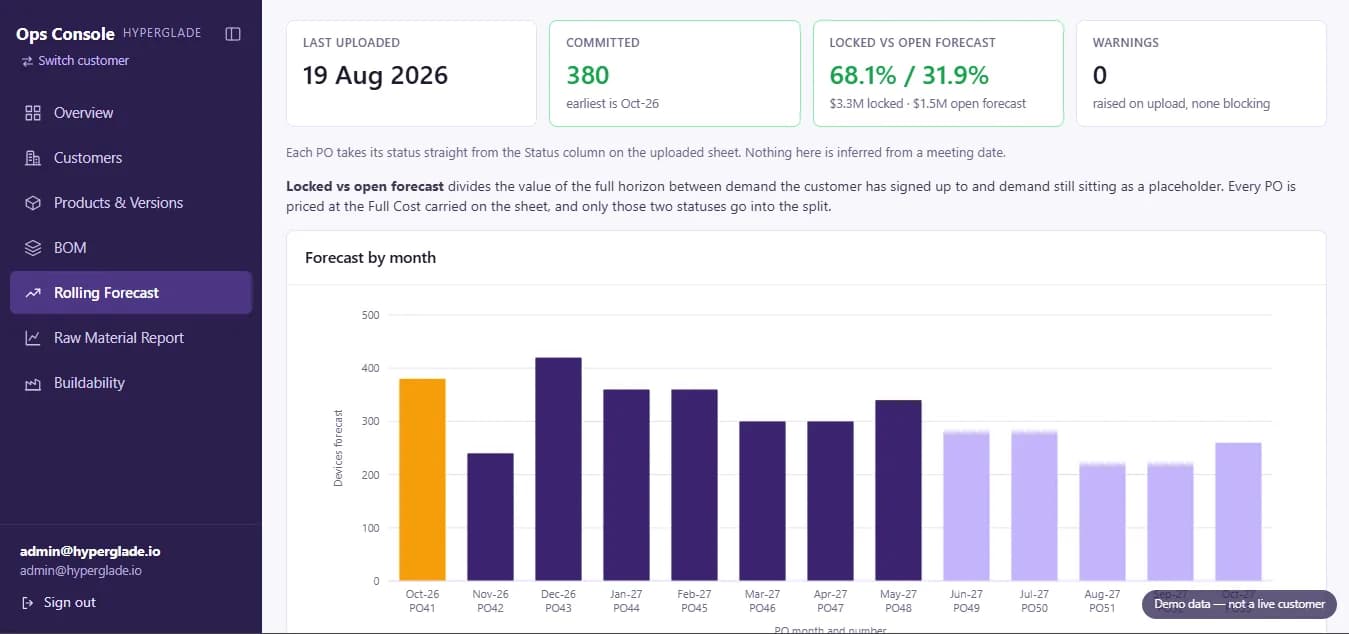
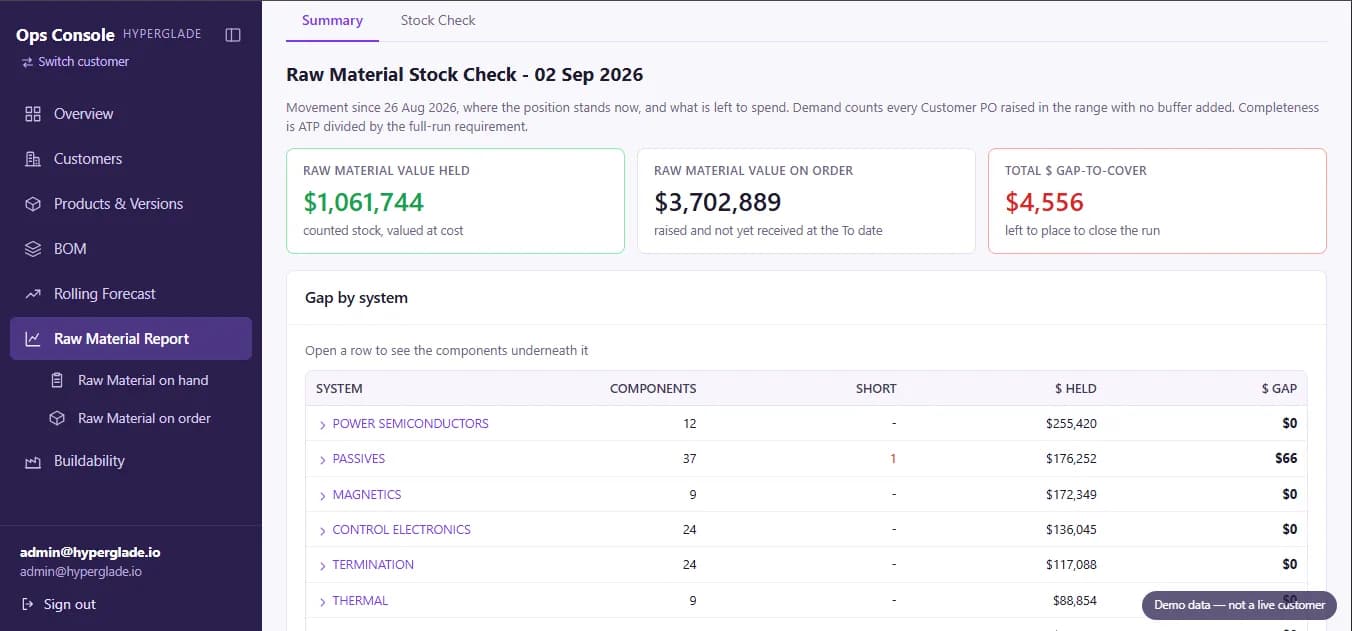
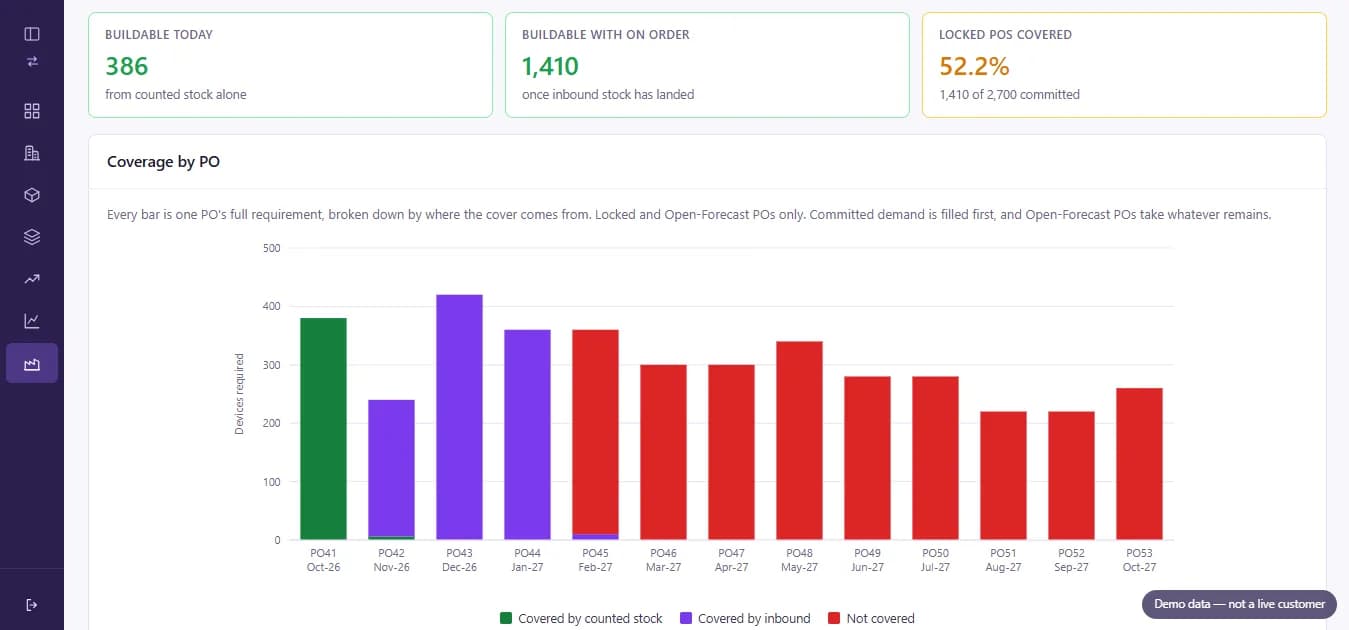
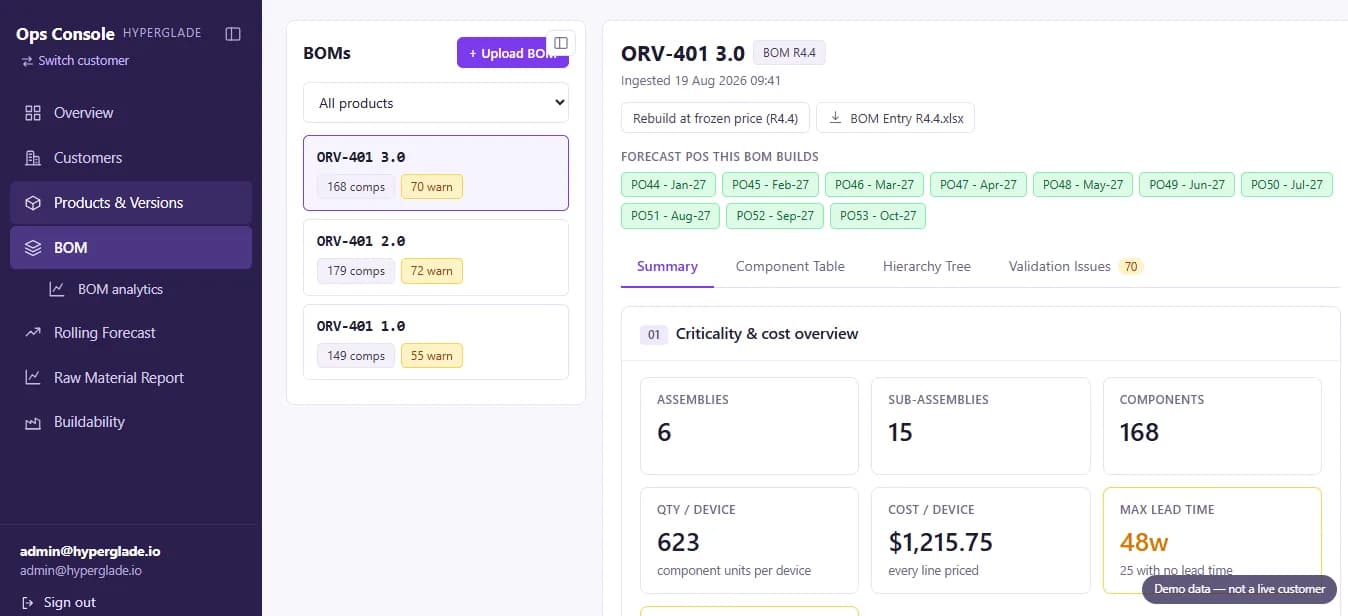
The three views it produces
Each one answers a question your current stack can't answer without somebody rebuilding a spreadsheet first.
Coverage
What you can actually build and ship against the orders you've already committed to — exploded to component level against accepted POs and locked BOM versions, so can we take this order stops being a judgement call.
Allocation Ledger
Which stock is reserved to which order. When two orders want the same component, you see the conflict before the floor does, instead of finding out at kitting.
Exposure Position
Capital at risk, sorted by reversibility. Some holdings can be cancelled today, some cut, some sunk. Priced separately, as these are different CFO conversations — only the reversible part is still your decision.
Speculative
Held against forecast, not against a binding order. Still fully reversible.
Committed
Ordered from supplier. Cancellation costs apply but remains an option.
In Production
Cut, machined, or part-built. The component lacks general-purpose use.
Finished & Waiting
Fully built, sitting in buffer store until want-date.
Proof

Wavetec
Wavetec, a wearable medical technology manufacturer under MAS Holdings, partnered with us to get a clearer handle on capital at risk.
See it running on one of your product families.
Bring one bill of materials and we will walk you through it live: what is committed, what is still reversible, and where the buffer is covering supplier variance instead of customer demand. Yours, not a sample account.